

Train Dreams | The Screenplay Lab
Narrating a Theme - 7 page deep dive

Welcome back to The Screenplay Lab. I’m Jeff Barker. I’m a screenwriter, and this is where we take one screenplay, break it down, and explore it as a literary work. Not just a blueprint for a film but a standalone piece of writing that’s rich, meaningful, and beautifully crafted on its own.
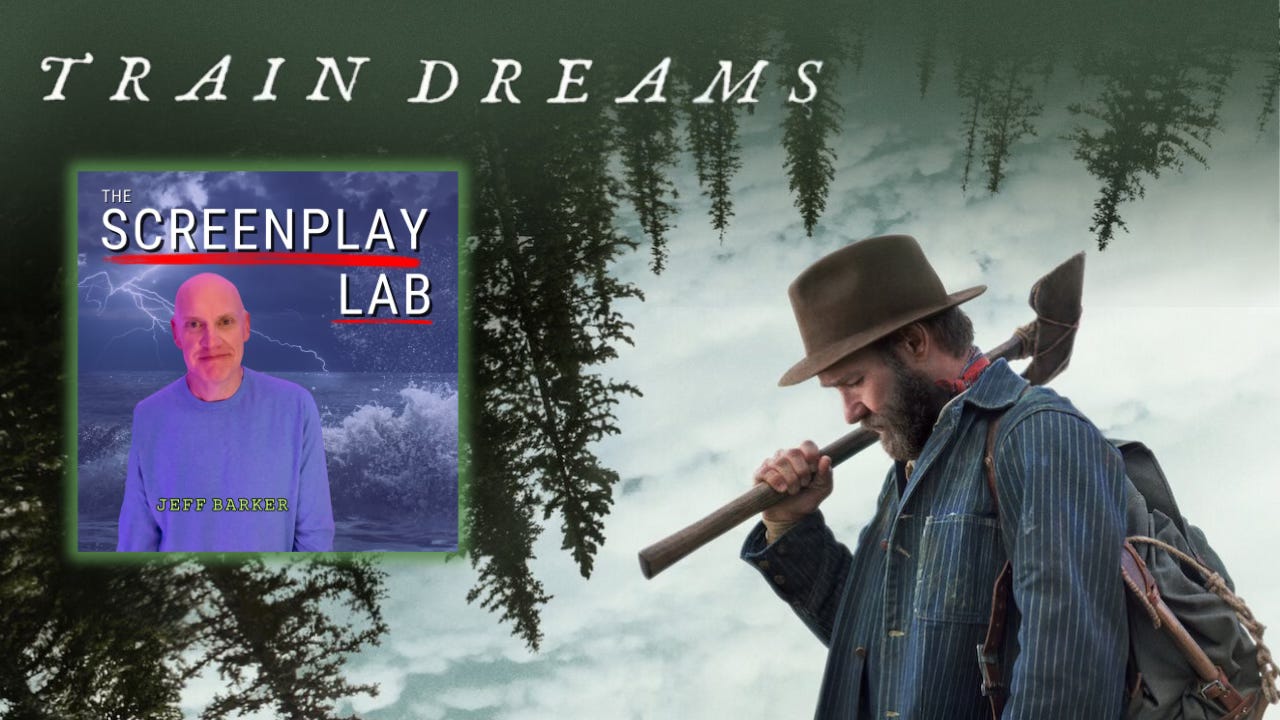
Train Dreams was one of the most beautiful and painful films of 2025, so I couldn’t wait to take a look at the Oscar nominated screenplay and see if the emotional landscape would be clear on the page.
This week we are breaking down the first four pages and the final three pages, word-for-word.
Train dreams comes from a 2002 short story that was adapted to a 2011 novella by the amazing Denis Johnson, who passed away in 2017. Clint Bentley and Greg Kwedar adapted the story for the screen, with Bentley directing. They also co-wrote Sing Sing, making them two-time Oscar nominated screenwriters.
I find it is best to do this with bullet points, because I can get more information out at a faster clip. I hope that works for you.
Page 1
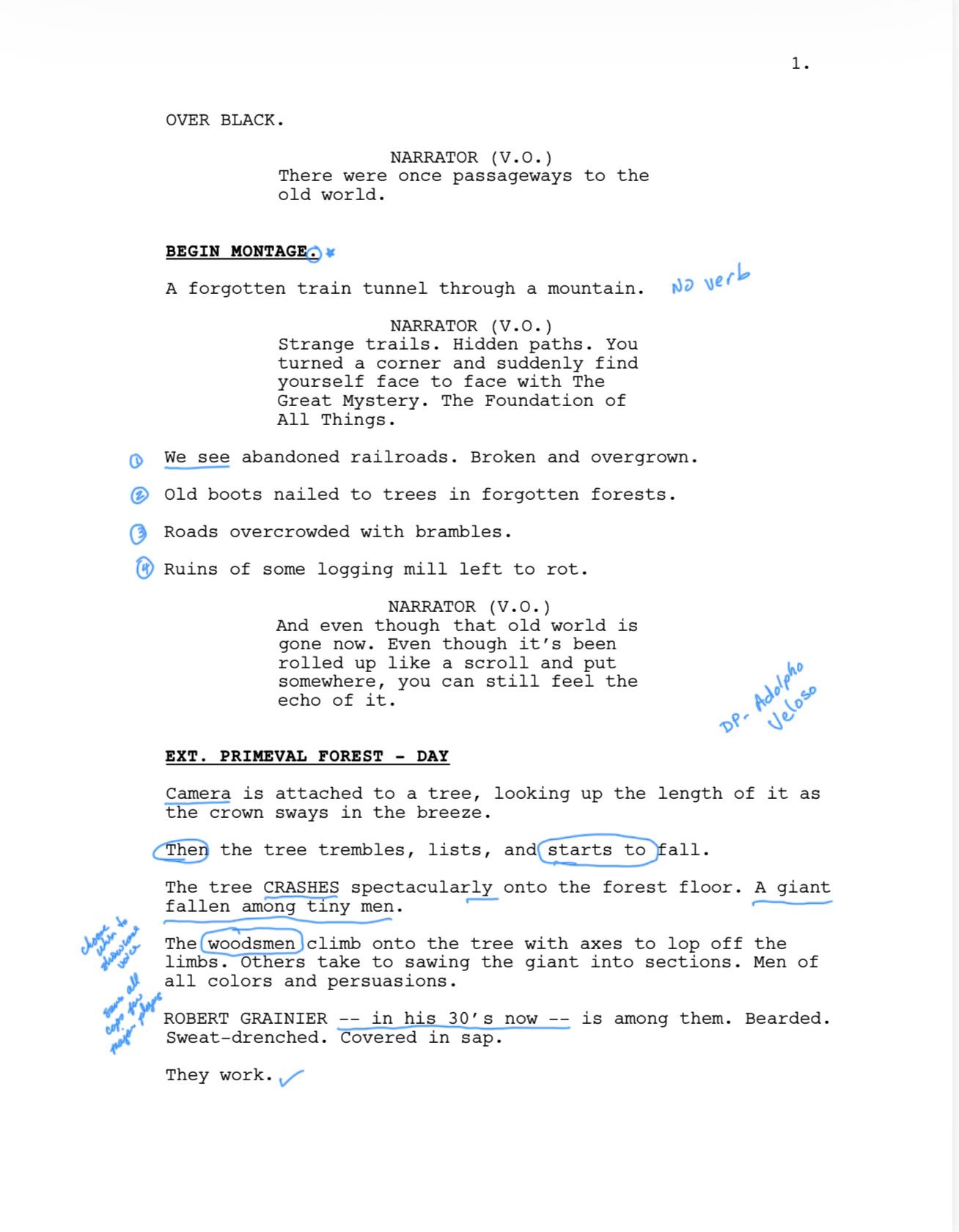
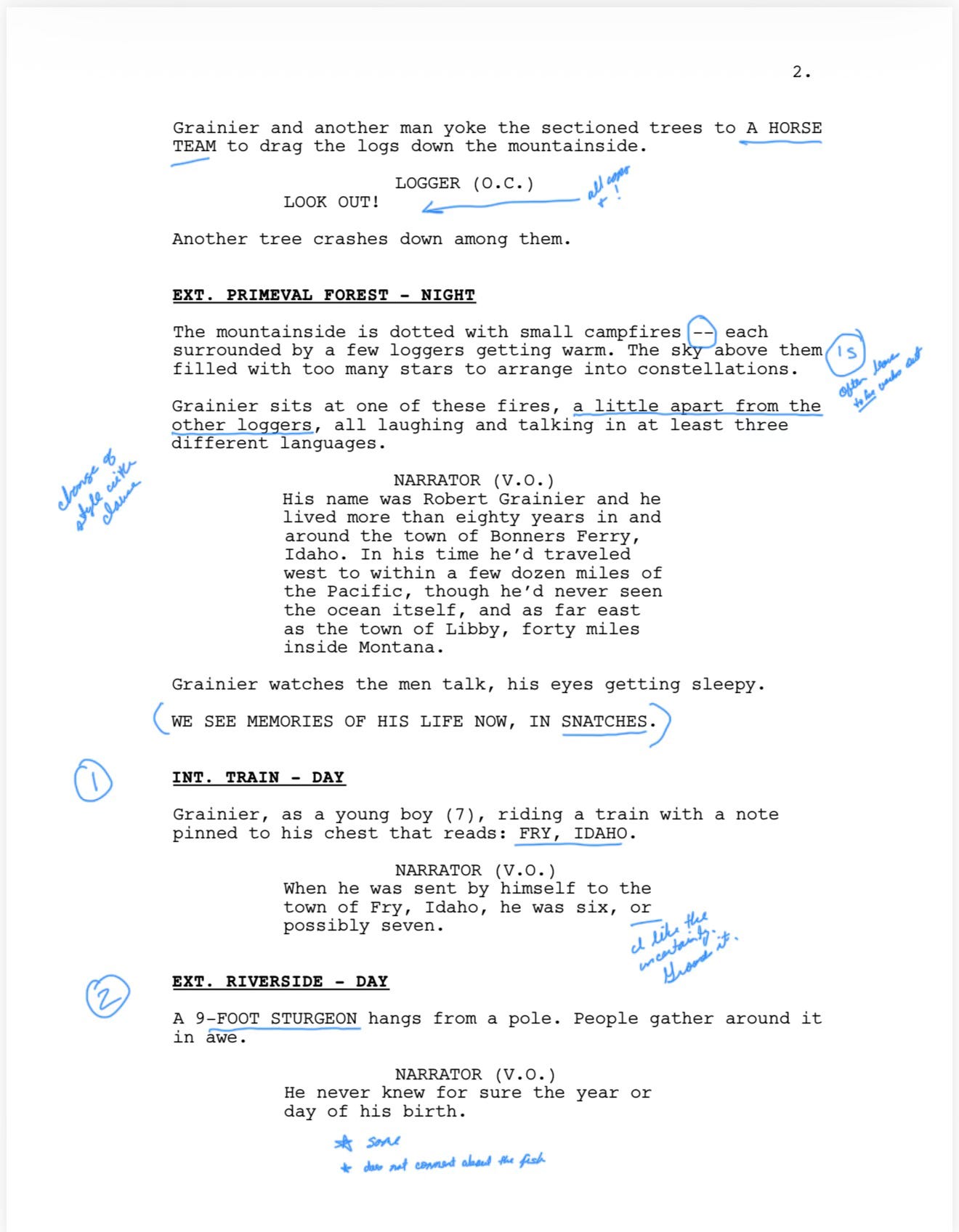
They start OVER BLACk with the narrator. The narrator carries the beginning and end of the screenplay. The main character doesn’t have a single line until page 5, despite being in every shot.
Opening montage is formatted like a scene heading, except they include a period at the end.
A lot of early lines opt to go verb-less in order to paint the scene with an abstract brush.
They don’t shy away from camera direction and framing on the page. The opening scene after the montage describes a camera setup (attached to a tree).
Some non-speaking characters are identified in ALL CAPS, some are not.
Notice the quick punchy sentences on this page: Bearded. Sweat-drenched. Covered in sap. They work. This is not the case throughout. We also get long flowing prose with multiple commas and clauses. I can identify two separate writing voices working on this script.
Page 2
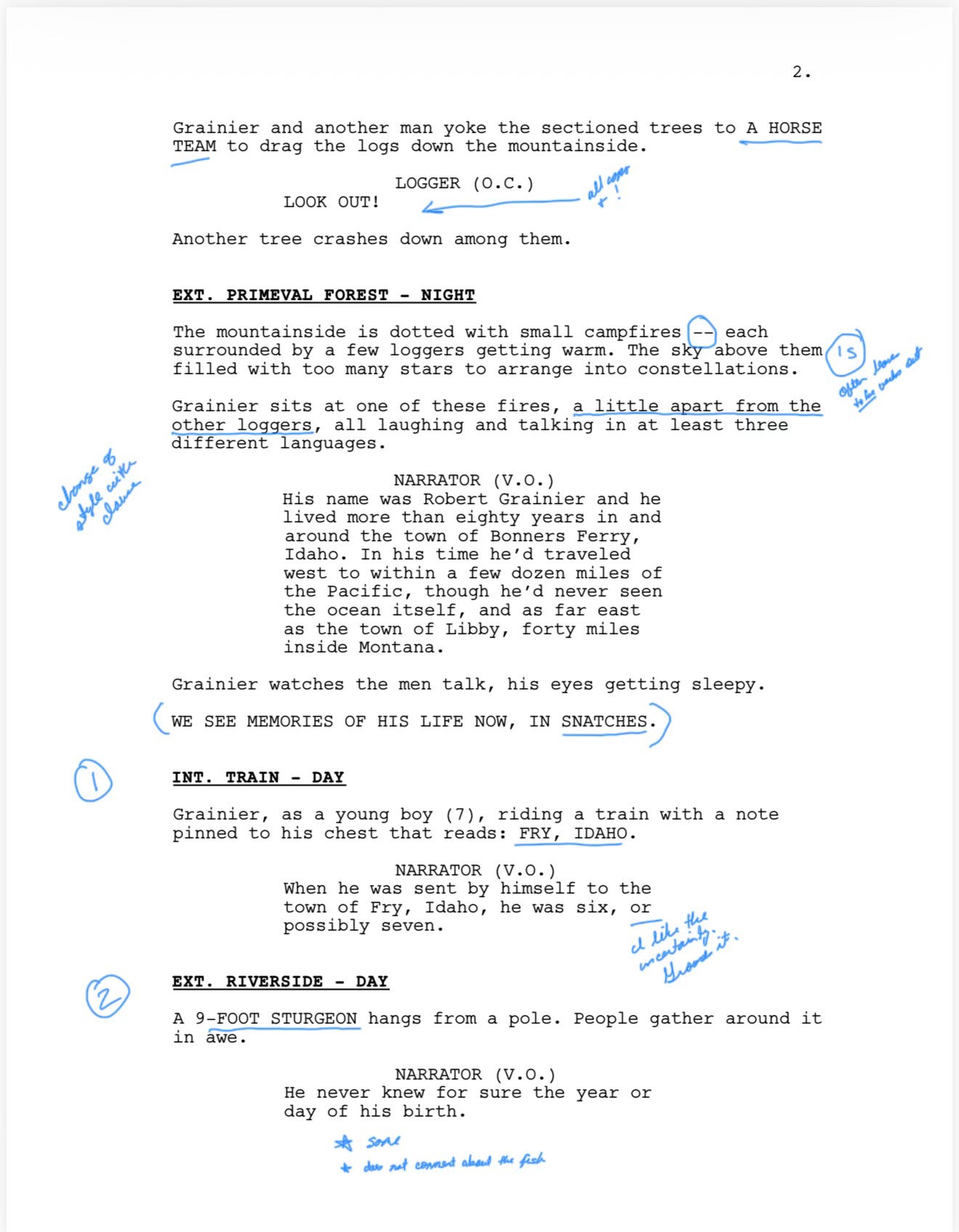
We get an exclamation point and all caps “LOOK OUT!”
They use double dashes -- for clauses, and often leave out to-be verbs.
SNATCHES and DREAMLETS are creative ways of identifying a series of shots, flashes, or montage.
The narrator and the images on the screen deviate to give the reader/viewer two story lines at the same time.
The backstory is given with some uncertainty which grounds the story and frames the information as coming from a third party that is filtered through the main character’s limited perception.
Page 97
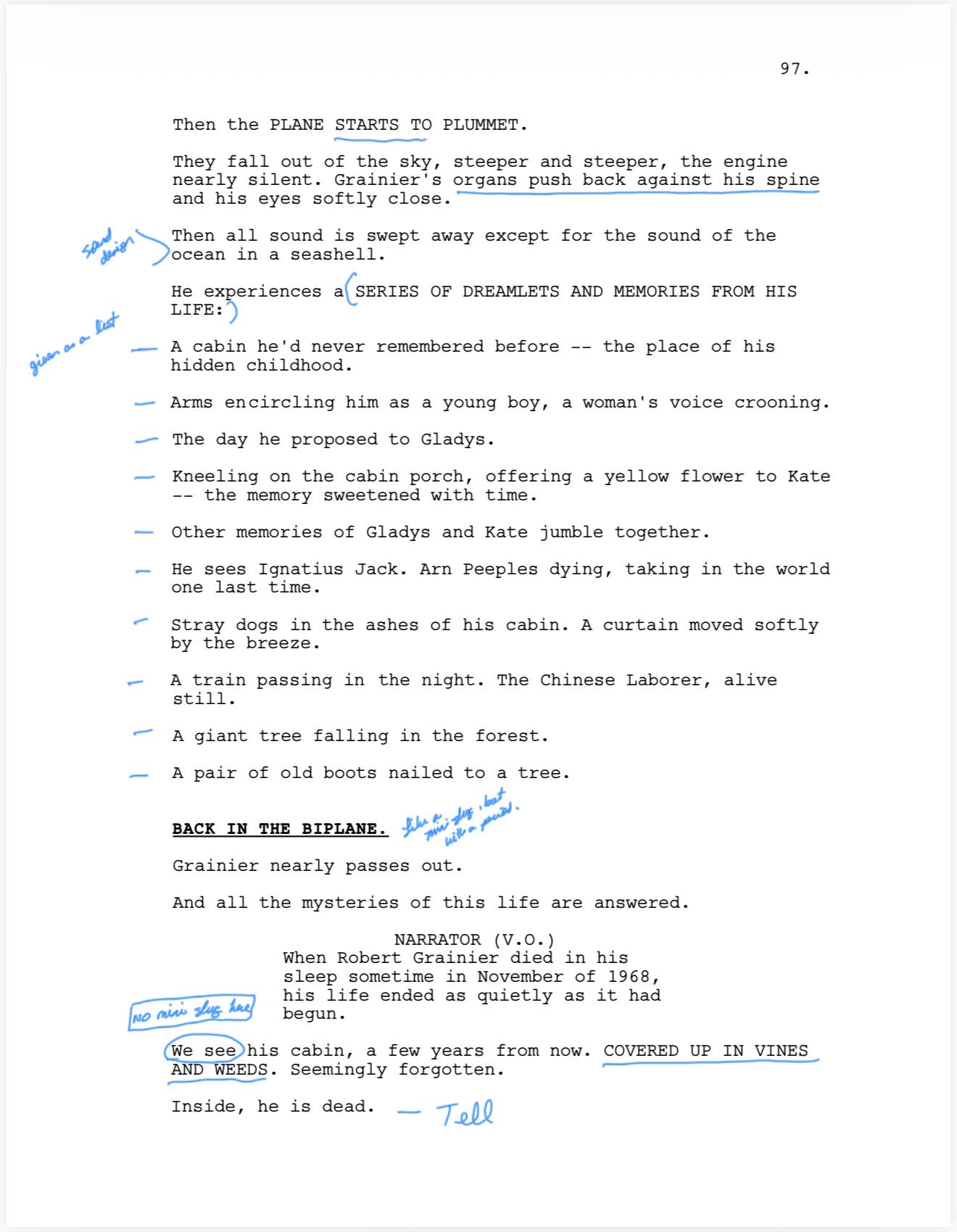
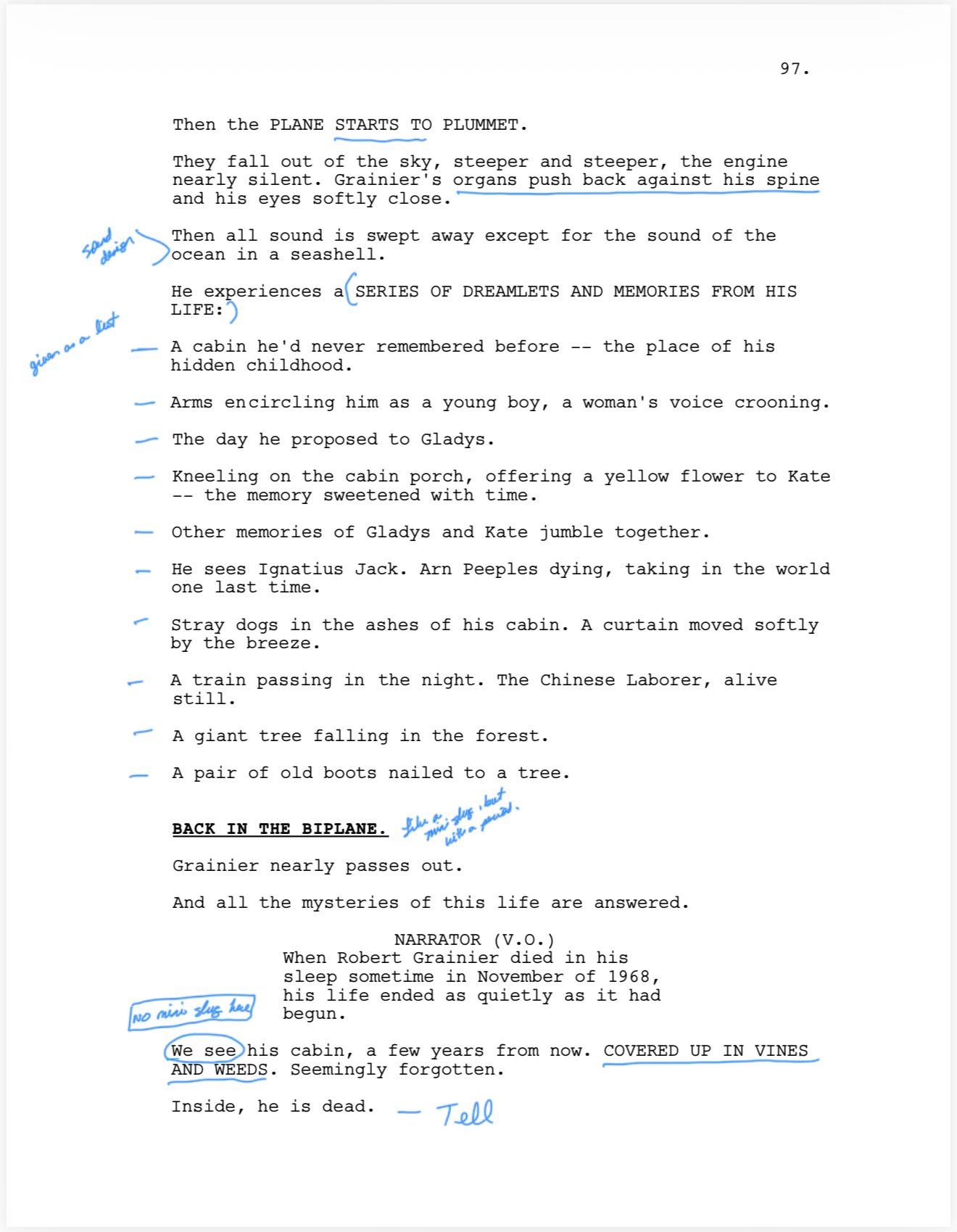
They often use hedge language such as “starts to.”
The final three pages drift into a lot of interiority and metaphorical prose. The writers take the liberty of explaining their themes both visually and with the text. It works in a screenplay like this, since the story is grandiose and broad. Hell, dealing with your won trauma in order to continue the hard work of existing is itself a metaphor. Perhaps that is the whole point.
Beautiful sound design on the page. This is where they really shine with atmospheric writing that presents as cinematic. Some of their transitions are truly breathtaking.
Here they break from the DREAMLETS with an ALL-CAPS announcement that is also underlined and in bold, with a period. Given the formatting we’ve seen throughout this screenplay, I don’t think we can consider this a mini-slug. They opt to not use it when they leave the plane and take us back to the cabin at the bottom of the page.
Notice the “we see.” We see that a lot.
As mentioned above, they indulge at the end, so we won’t consider it a lack of discipline. For example, they show us he is dead, the narrator tells us he is dead, and then the action line says, “Inside, he is dead.”
Pages 3, 4, 96, 98
For more pages and a deeper explanation of the previous pages, check out the podcast. You can watch it on YouTube or listen to it on Apple, Spotify, etc.
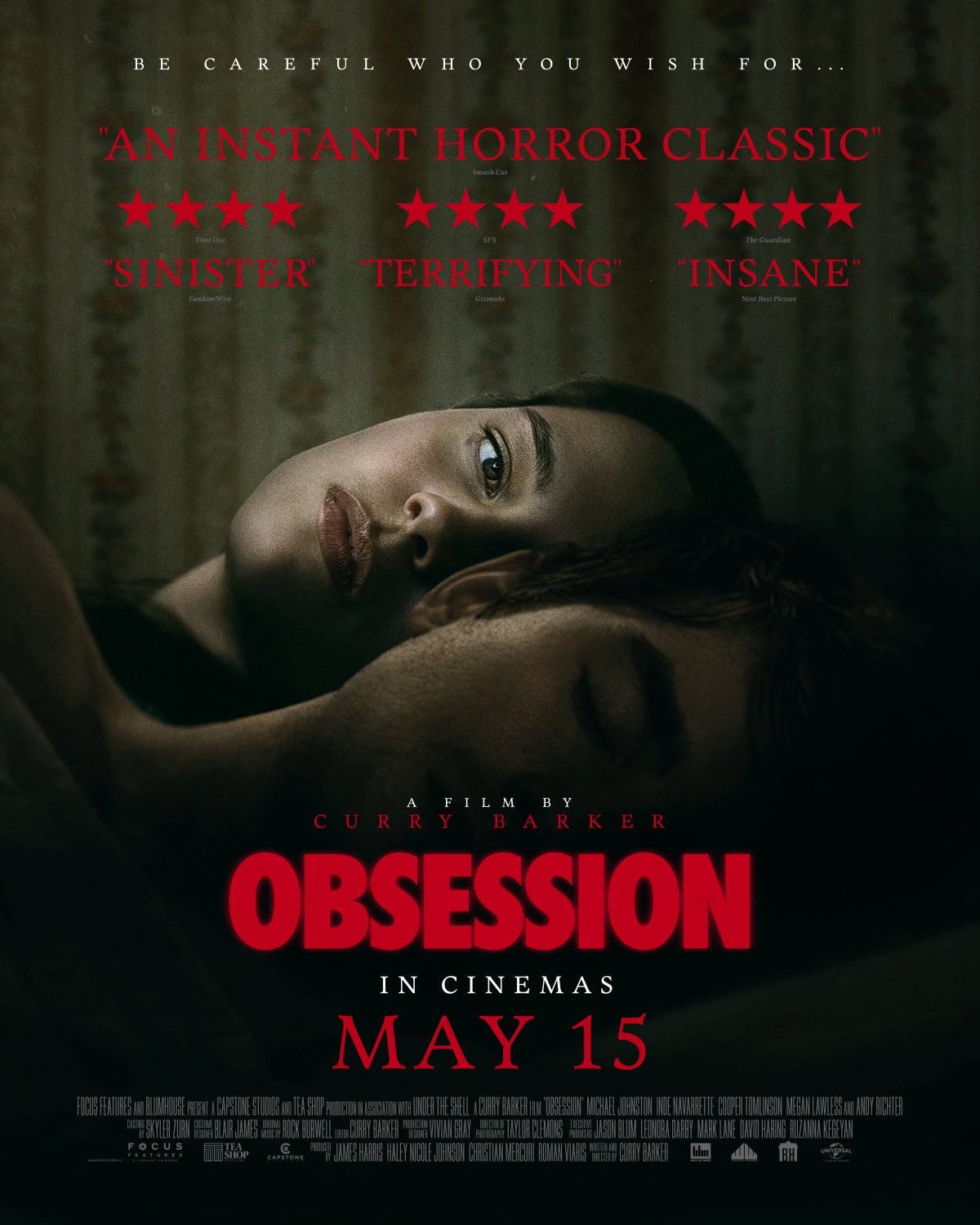
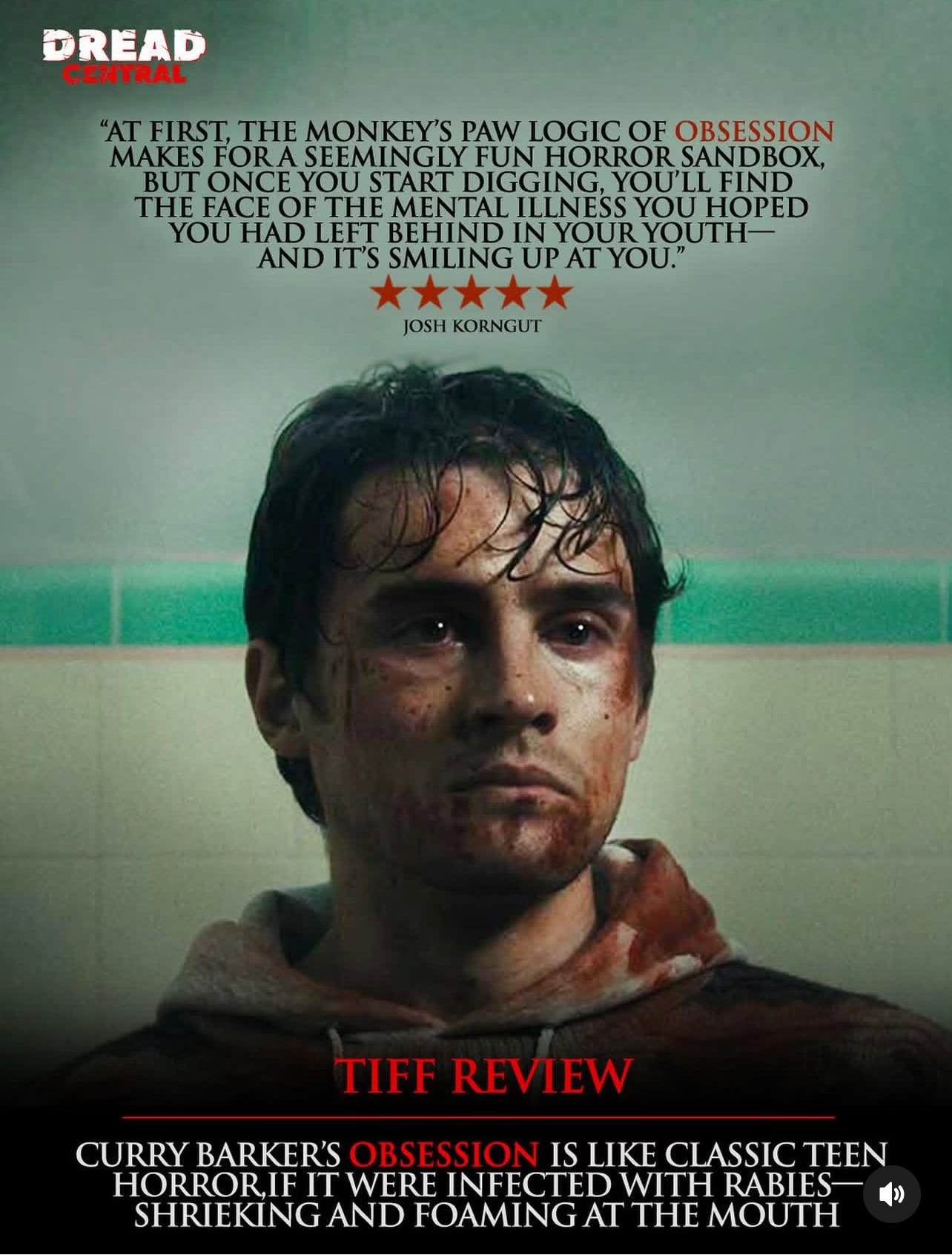
OBSESSION
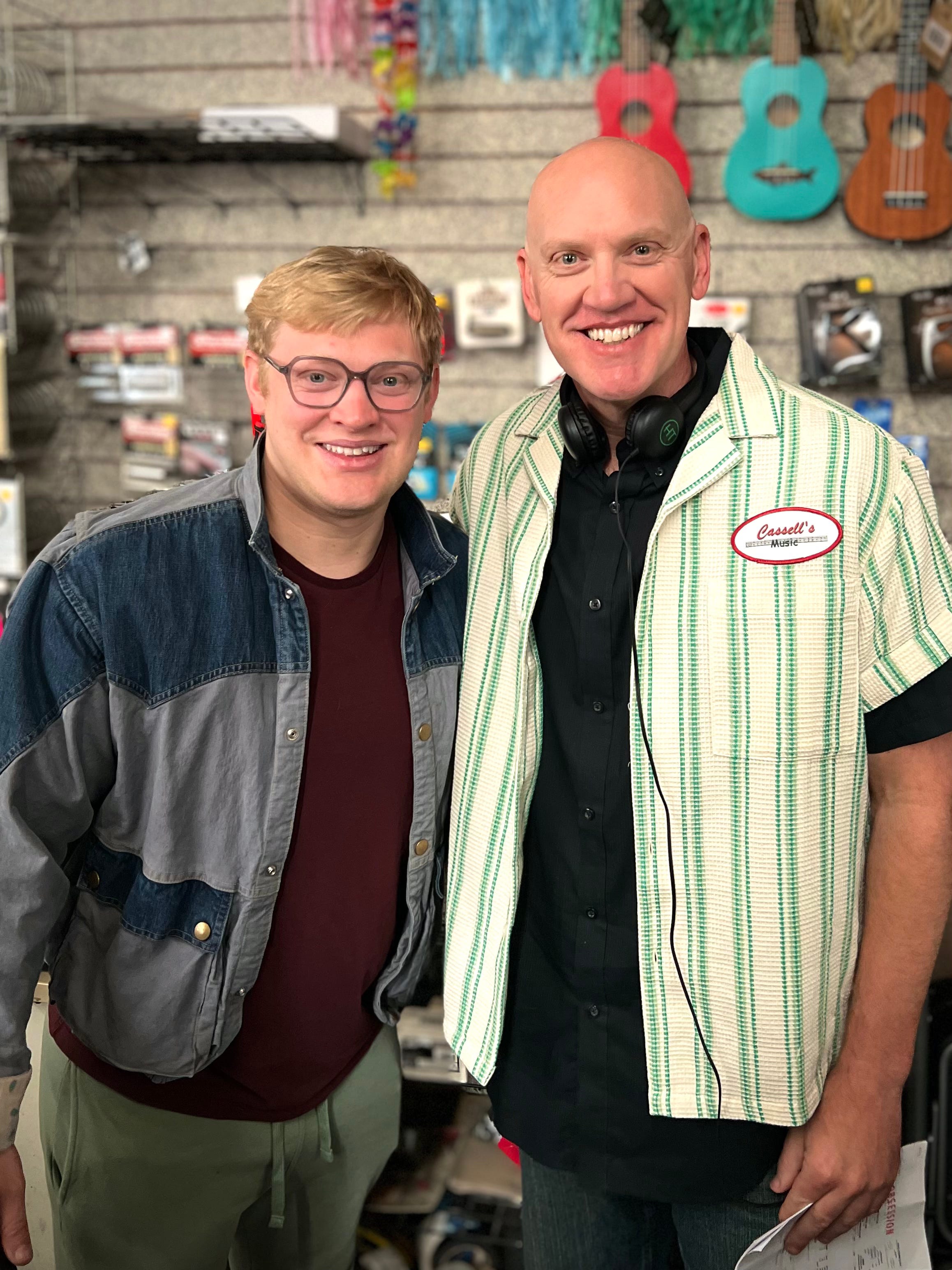
I cordially invite you to watch my son’s film, Obsession. It’s coming to a theater near you on May 15.
Gotta be one of the most pedantic screenplays in years.
The narration reading stage directions removes what little subtext the narrative has.
Train Dreams is anti-cinema. It’s a multi-million-dollar podcast.
Some of the language in the screenplay is taken directly from Denis Johnson’s novella and some original language definitely mimics Johnson’s voice in powerful ways.